Past Events

Walk 26 November 2023

2023-11-26

NOVEMBER BIRD WALK

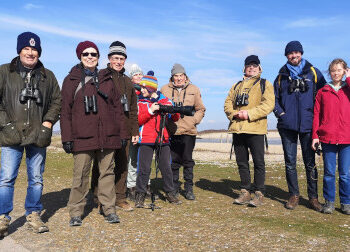
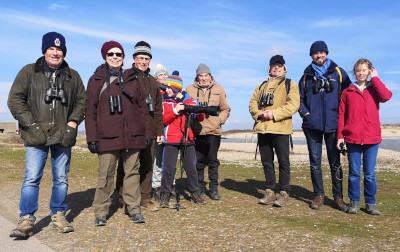
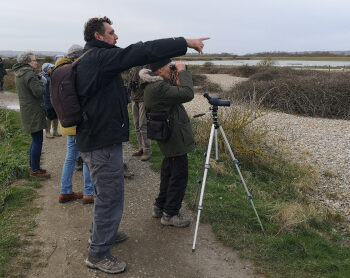
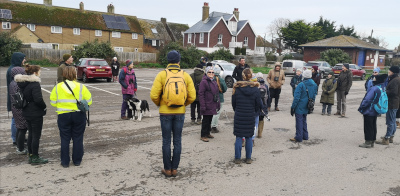
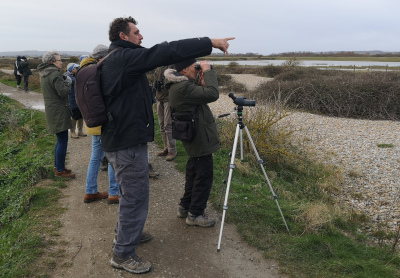
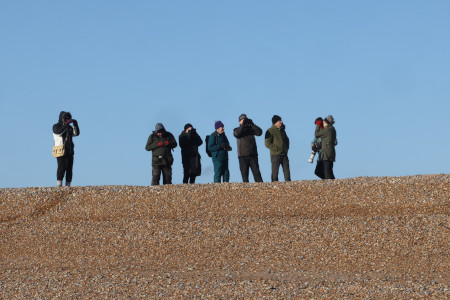
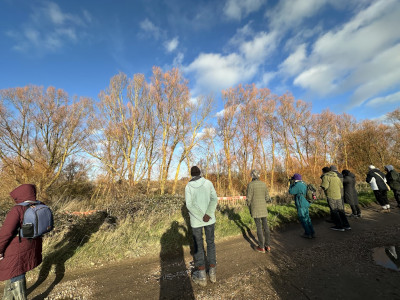
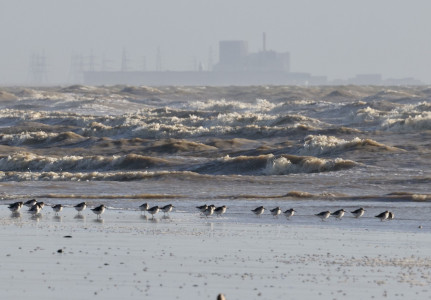
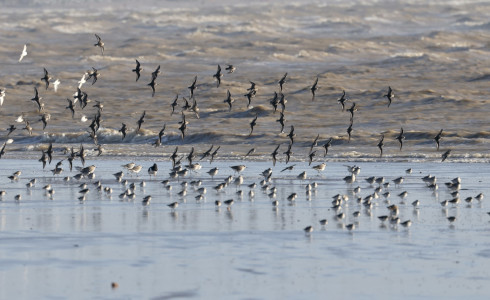
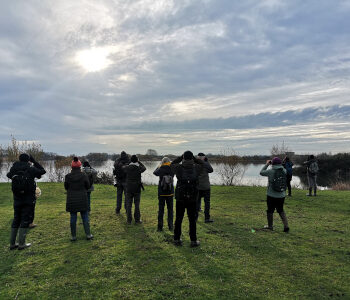
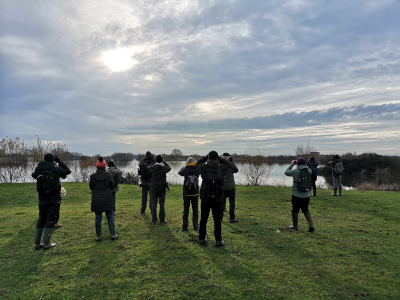
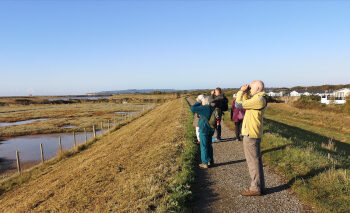
We had a good turn-out of 16 for today’s Friends’ walk to Castle Water, in weather that was grey and cool but clear and very still so that sounds could easily be heard, be they birds, church bells, Sunday motorbikes or the trumpeting of the Marshlink as it approached Rye Station.

In order to reach that part of the reserve, we have to walk for 15 minutes up Harbour Road, which I tend to see as birdless, so sometimes punctuate that part of the trip with information about the village and its history. However this dismissal is unjustified, for there are quite lot of birds to be seen. Apart from marshland species like Gulls and Waders passing overhead, and garden birds like Sparrows, Robins and Blackbirds ,there was this morning a Mistle Thrush broadcasting its rich contralto to the whole neighbourhood from the top of the tallest Sycamore. We hear it every spring, when it can still be heard well down the track to the Discovery Centre, then after a few months’ pause, it sings again from late autumn, really getting under way from the solstice.

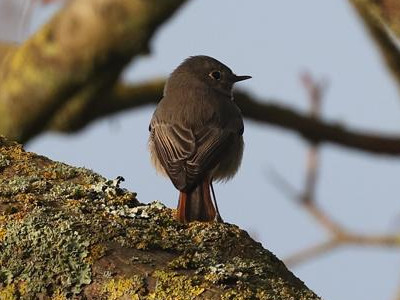
Black Redstart

A little further on, a Robin-shaped bird attracted attention as it perched on the roof of an asbestos shed in an overgrown yard. Though anonymous in silhouette, the game was given away when its tail quivered, revealing it as a Black Redstart, a bird which breeds right the way from central China to W Europe, where it finds the Channel a disincentive. So once you cross the water, you can find it in almost every town and farm, but at RHNR we see them only on migration or in winter. It is a scarce breeder in England, preferring industrial and derelict sites to the (similar) rocky mountain habitat where it can be found right up to the snow-line, and a small number of pairs can be found between Cliff End and Hastings Town Centre. By the way, this one wasn’t Black but grey, a female or young male.

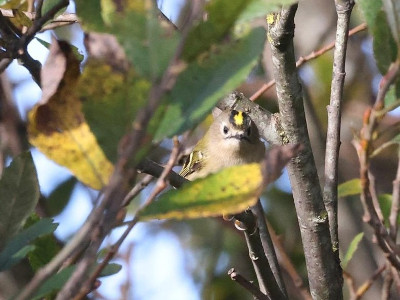
While we were watching this little bird, showing its red tail as it flickered around the black anchor across the road, there were Long-tailed Tits and Goldcrests foraging in the roadside Sycamores and Golden Plovers racing overhead.

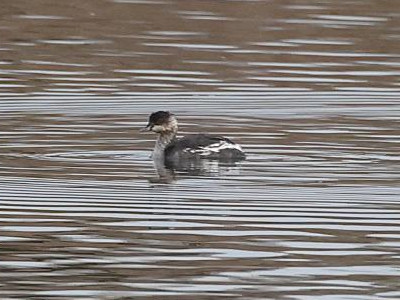
Black-necked Grebe

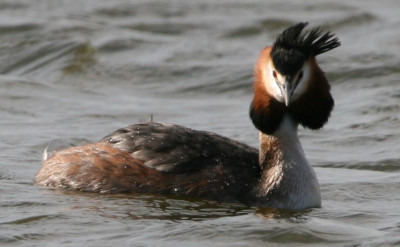
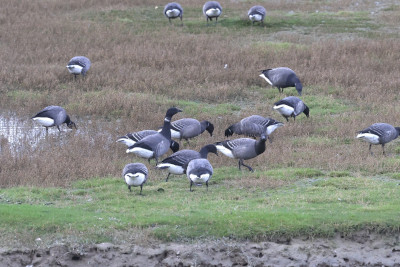
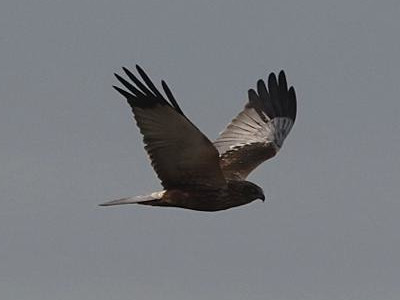
We saw or heard 62 species – see the list below (not everyone sees everything) – including Marsh Harriers, Buzzards, Sparrowhawks, a Peregrine, Ravens, flocks of Fieldfares just in from Scandinavia and masses of wildfowl at Castle Water  including Shelduck – just back from moulting on safe sand-banks in Heligoland – and a Black-necked Grebe, first noted a couple of days ago. If it is the same individual – and its habits suggest so – it first arrived in March 2021 then sat in very much the same spot for the rest of the year, moulting into glamorous breeding plumage without finding a mate to be impressed by it. The bird remained throughout 2022 until this spring when it vanished – till now. Where has it been over the summer? Did it find love? This is another bird which can be found nesting from just outside Calais right into Central Asia but is scarce in England – mostly in the E & Central areas. It’s another example of how Rye Harbour is On The Edge.

Marsh Harrier

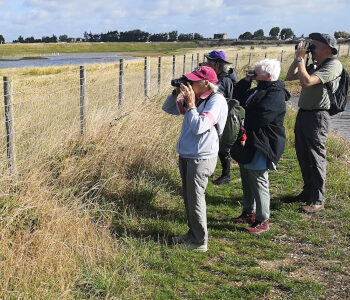
These walks are a convivial way to share information, knowledge and skills with everyone finding something to contribute, from an extra (maybe better) pair of eyes to the latest useful app or experience from different regions. Leaders do their best to make sure everyone sees or hears the birds, learns how to look for and identify them, understands what the birds are doing, where they’re from and where, if anywhere, they’re going.

https://app.bto.org/birdtrack/pubcon/shared?subId=SUB47721064

Past Events

Walk 11 Nov 2023

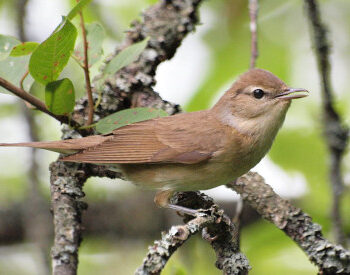
Eleven of us turned up to enjoy this month’s beautifully sunny and warm walk around Flat Beach. We had already enjoyed views of a Spoonbill sweeping the shallow water of a pool on the saltmarsh when we came across a Dartford Warbler in the brambles at Cuckoo Corner. One or two of these little heathland birds winter on the reserve in most years though it’s not clear where they come from. Not Dartford, certainly, though that’s where the first type-specimens were “collected” (ie shot) in the late 18th century. (Actually it was Bexleyheath, at that time a desolate area still frequented by highwaymen.) The nearest few pairs breed not far away at Hastings Country Park.

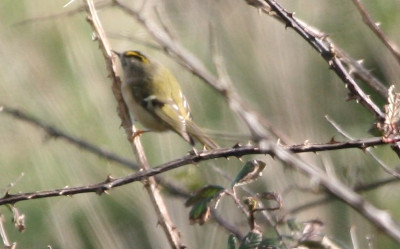
Dartford Warblers are long-tailed, skulking scrub-birds, usually hard to see well and they either hide or flit from bush to dense bush but we didn’t have to wait too long before it perched up on a Hawthorn, showing off its grey-brown upper-parts, deep pink breast and red eye in the sunshine.

This and the spoonbill were new species for some on the walk and we then searched for – but failed to find – something even scarcer: a Grey Phalarope which had been present for the previous two days. This is an arctic-breeding wader which winters well out in the Atlantic but was one of many oceanic birds driven onshore by recent storms. It had been on a flooded field which remains unnamed on the Picturemaps Tea-towel on sale in the Discovery Centre (on which all other known sites are identified). It has been suggested that the adjacent “Pool With No Name” might be called the “Sand Martin Pool” on account of the wall-with-holes installed there years ago to encourage them to nest. However, they have never shown it any interest and it’s now completely underwater.

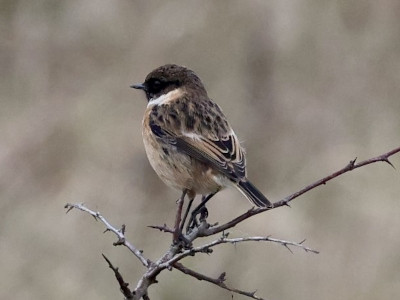
We don’t just concentrate on scarce species; we saw a lot of other birds – more than 50 species – including several Stonechats, a Kingfisher and hundreds of varied waterbirds, all of which noisily took flight at the detonation of the 11 o’clock Armistice Day maroon.

Past Events

Walk 22 Oct 2023

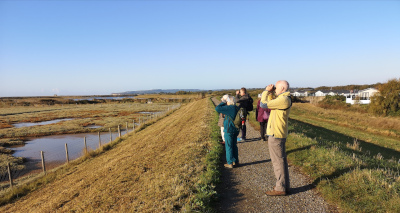
After the wind and heavy rain of the previous day, we had brilliant, calm and remarkably warm conditions for our Friends’ walk on Sunday, which took us beyond Salt pool as far as Barn Pools then across to the beach. We saw a fantastic variety of birds, with very good views of many.

Other people we met expressed surprised that Swallows were still dashing through in late October but the 2021 Sussex Bird Report cites  December 5th as the 10-year average  last date (while in that year, the last Swallow was seen on Dec 31st!) From the car park we had already seen House Martins over the village (10-year average, November 20th).

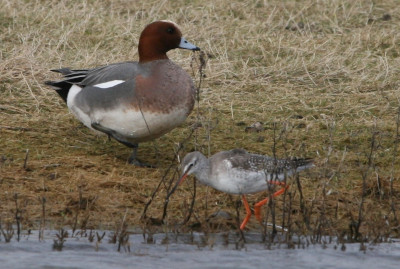
Duck numbers (at least Mallard, Wigeon & Teal are building up on Salt Pool) but the real drama there was provided by hunting packs of Cormorants and mixed herons (Grey Heron, Little & Great Egret) corralling fish in the shallows then all suddenly decamping to a new location with a great flapping of black, white & grey wings. 3 Great Egrets, with long, snaky white necks and big yellow beaks, took little notice of us as we passed them; it was hard to believe that they were very rare here till less than 20 years ago. On the ground nearby we had close views of 2 beautiful Golden Plovers.

Another summer migrant still present, mostly alongside Narrow Pits, was Chiffchaff. We must have seen 10, especially in the company of roaming bands of Long-tailed Tits (more than 20 of these following the stream by the holiday park). But no “last date” is given for Chiffchaffs since, while some proceed south, others stay for the winter.

Overhead, we could frequently hear calls from Siskins and Redpolls but against the bright blue sky they were very hard to see, like the Sparrowhawk which passed low at high speed but unlike a Marsh Harrier circling up in the sunlight. The conifers by the Barns often provide cover for Goldcrests and, with a bit of patience, we were able to pick out 3 of them moving through the dark foliage.

From Crittall Hide, we were alerted by the angry croak of a couple of Crows to a brown young Peregrine they were persecuting high above Ternery Pool and as we watched them twisting and turning, we also picked out couple of distant Buzzards. 

We saw/heard 69 species, though not everyone saw or heard all of them, while other people on the reserve recorded at least a dozen in addition. To see the list, click on the link below:

https://app.bto.org/birdtrack/pubcon/shared?subId=SUB47564540

Past Events

Walk 14 Oct 2023

Six of us joined the Friends’ 08.30 Walk beneath a pure blue sky full of lark song. Swallows streamed across the salt marsh where the dazzling low sun raked rusty samphire and glaucous purslane while silhouetted Avocets swept the shallow pools.

As the Swallows are leaving, other birds arrive: Four Blackbirds could have been arrivals (especially one flying high over the village) and we saw about ten Stonechats around Flat Beach.

On Salt Pool, just beyond grazing Wigeon sat a solitary Brent Goose, but our attention was directed more towards the spectacle of 2 Kingfishers which often hovered for several seconds at a time, their backs flashing in the sunshine.

It’s always fun to estimate, then try counting, the long line of Cormorants roosting on Ternery Pool; the results vary but come out at around 350.

A last departing Wheatear consorted with Linnets among silvery grasses on the shingle, a vanguard of Golden Plovers could be heard piping and the first Rock Pipit of winter squeaked over the Discovery Centre.

Past Events

Open Day Walk 12 Aug 2023

On our Open Day 0830 walks round Flat Beach we’d normally expect see around 50 bird species but today, with most breeders dispersed and winter birds still to arrive, we found just 35.

Nonetheless, it was a beautiful sunny, breezy morning with clear light and excellent visibility. Two of the group were first-timers and so enjoyed picking out migrant Common Sandpipers and lingering Common Terns as well as practising counting a scuttling band of House Sparrows and lined-up Cormorants.

From Parkes Hide, where the waters of Ternery Pool were an extraordinary green, we shared great close views of Little Egret & Little Grebe with a visiting family. We could hear calls of Curlew & Whimbrel, an overhead Dunlin and a rushing flock of Ringed Plovers.

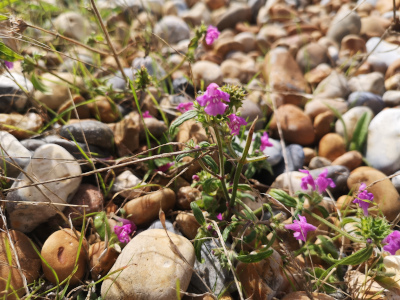
As usual on summer walks, we spent some of the time learning and revising plants, such as Wild Carrot, Wild Parsnip and Red Hemp-nettle.

Returning along the riverside path, we saw Wheatears perching on fence posts and a human perched on the roof of the Soon-To-Be-Even-Redder-Roofed Hut*.

*Please note that the Red-roofed Hut is privately owned and is NOT part of the Reserve.

Past Events

Open Day Walk 08 April 2023

A fabulous start to the morning walk, so still that water perfectly mirrored the blue sky and birdsong rang out so clearly that a Mistle Thrush up at Coastguard Square could be heard right down by Nook Drain and the air over the saltmarsh was full of Skylarks. The calls of returning Avocets can be heard everywhere now everywhere now, while flocks of Dunlin and Ringed Plover are feeding hungrily before continuing their journey northwards. The closeness of the path to the edge of the Salt Pool gave us excellent views of these while three newly-arrived Little Ringed Plovers, scuttling along the edges to in flight allowed us to appreciate the features which distinguish them from Ringed Plovers.
While watching these waders we noticed small insectivorous migrants searching the turf: White Wagtail with a pure, pale grey back, an apricot-fronted Wheatear and a dazzling Yellow Wagtail.
Although some common birds were mysteriously missing, the variety is increasing, so that along this short route we found 56 species.